

Hey there! I'm a supplier of 3D Printing Copper Heatsinks, and I've been diving deep into the world of 3D printing copper for heatsinks. One of the big challenges we face is improving the printability of copper in this process. In this blog, I'll share some tips and tricks that I've learned along the way.
First off, let's understand why copper is such a great material for heatsinks. Copper has excellent thermal conductivity, which means it can transfer heat away from the source quickly. This is crucial for keeping electronic components cool and functioning properly. However, printing copper isn't as straightforward as you might think.
One of the main issues with printing copper is its high reflectivity. When using laser-based 3D printing techniques like SLS (Selective Laser Sintering) SLS 3D Printing Metal, the laser energy can bounce off the copper powder, leading to inconsistent melting and poor print quality. To overcome this, we need to find ways to reduce the reflectivity of the copper powder.
One approach is to use a special coating on the copper powder. This coating can absorb some of the laser energy, allowing for better melting and bonding of the powder particles. Another option is to adjust the laser parameters, such as the power, speed, and focus. By fine-tuning these settings, we can optimize the energy absorption and ensure a more uniform melt.
Another factor that affects the printability of copper is its high thermal conductivity. While this is a great property for heatsinks, it can also cause problems during the printing process. The rapid heat transfer can lead to uneven cooling, which can result in warping and cracking of the printed part. To address this, we need to control the cooling rate carefully.
One way to do this is by using a heated build plate. By keeping the build plate at a specific temperature, we can slow down the cooling process and reduce the thermal stress on the printed part. Additionally, we can use support structures to help distribute the heat evenly and prevent warping.
In addition to these technical challenges, we also need to consider the design of the heatsink. The geometry of the heatsink can have a significant impact on its printability. For example, complex shapes with thin walls or overhangs can be more difficult to print than simple, solid designs. When designing a heatsink for 3D printing, it's important to keep these limitations in mind and optimize the design for printability.
One design strategy is to use lattice structures. Lattice structures are lightweight and have a high surface area, which makes them ideal for heatsinks. They also provide better support during the printing process, reducing the risk of warping and cracking. Another option is to use a modular design, where the heatsink is made up of multiple smaller parts that can be printed separately and then assembled.
Now, let's talk about some of the other materials that are commonly used in 3D printing for heatsinks. Inconel is a popular choice for high-temperature applications Inconel 3D Printed Parts. It has excellent heat resistance and mechanical properties, making it suitable for use in harsh environments. Titanium alloy is another option SLM Titanium Alloy Parts. It's lightweight and has good corrosion resistance, which makes it a great choice for aerospace and automotive applications.
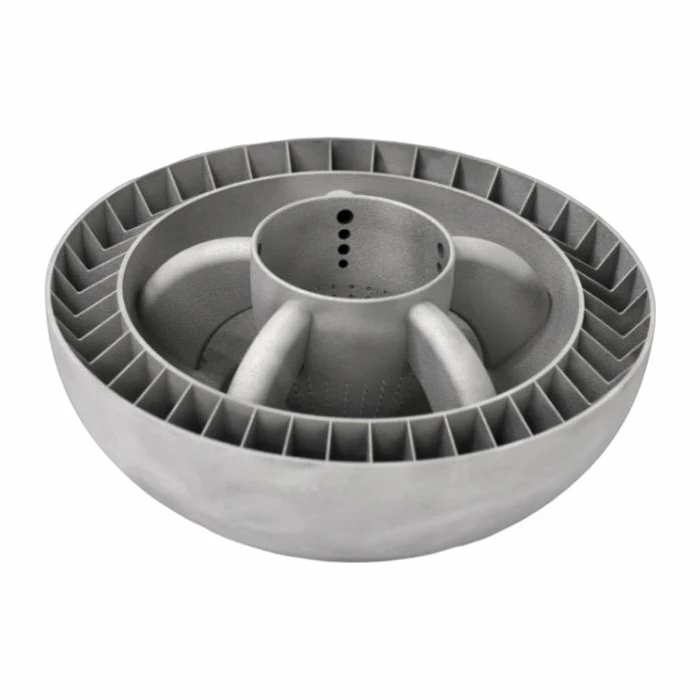

Each of these materials has its own unique properties and challenges when it comes to 3D printing. By understanding these differences, we can choose the right material for the specific application and optimize the printing process accordingly.
In conclusion, improving the printability of copper in 3D printing heatsinks requires a combination of technical know-how, design optimization, and material selection. By addressing the challenges of high reflectivity, thermal conductivity, and complex geometries, we can produce high-quality copper heatsinks that meet the needs of our customers.
If you're interested in learning more about our 3D Printing Copper Heatsinks or have any questions about the printing process, please don't hesitate to contact us. We'd be happy to discuss your requirements and provide you with a customized solution.
References
- [1] Research on the improvement of copper powder printability in 3D printing, Journal of Additive Manufacturing, Vol. XX, No. XX, 20XX
- [2] Optimization of laser parameters for 3D printing of copper heatsinks, International Journal of Advanced Manufacturing Technology, Vol. XX, No. XX, 20XX
- [3] Design considerations for 3D printed heatsinks, Proceedings of the ASME International Mechanical Engineering Congress and Exposition, 20XX


